SynchroShift / Complexity → Solution
Product design case / selected flow
Complex operational problem → usable system

Scheduling is not a calendar problem.

It is a constraint problem: availability, roles, staffing levels, contract hours and operational rules all have to work at the same time.

Why this flow first

Of SynchroShift's AI-assisted workflows, schedule generation carries the highest operational risk: a wrong output can create an invalid or unstaffed shift. I went deep here first because resolving its failure modes also de-risks simpler flows that can inherit the same constraint logic.

Move complexity into the system — without taking control away from the manager.

This short case focuses on one problem only: generating a workable schedule when several business constraints collide.
Case focus: reasoning, not a product walkthrough. The interface is deliberately secondary here; the story is how operational complexity becomes a constraint model and a testable product hypothesis.
The test: does this reduce the manager's checking work, or simply move it somewhere else? I return to that question in Validation.
01 / Complexity

One shift. Multiple constraints.

A schedule can look complete and still be wrong. The system has to distinguish between someone being available, eligible for a role, contract-compliant and actually useful for coverage.

Monday / 10:00–18:00
2 people minimumCore staffing requirement for most of the day.
1 manager roleManager or Assistant Manager must be present.
4h minimum shiftAvoid fragmented micro-shifts.
1 person last hourCoverage rule changes from 17:00–18:00.
10
11
12
13
14
15
16
17
Anna · Sales · until 16:00
Peter · Manager · contract limit risk
Sara · Available · wrong role
coverage gap
This scenario combines recurring scheduling constraints I observed through years of working in retail and interacting with employees and managers — including sickness, holidays, role coverage, extra hours, weekends and peak periods. It is a representative scenario, not a single captured incident.
02 / Reasoning

Why obvious solutions fail.

The first product decision was to stop treating “free time” as the same thing as “assignable”. Each assignment has to survive several independent checks. If an invalid schedule reaches publish, the consequence is operational: understaffed hours, last-minute manager intervention, or avoidable labour cost.

01

Available ≠ eligible

Sara is free, but if the requirement is Manager or Assistant Manager, assigning her would create a valid-looking but operationally invalid schedule.

02

Eligible ≠ compliant

Peter has the correct role, but assigning him may exceed his contracted hours or another defined staffing rule.

03

Compliant ≠ good

A schedule can technically satisfy rules and still create poor continuity, fragmented shifts or an avoidable coverage gap.

03 / Model

Separate what must hold from what can improve.

The scheduling engine works better when hard constraints are treated as non-negotiable, while soft constraints are used to optimise among otherwise valid options.

Hard constraints / must never be violated
Required role Employee availability Minimum staffing Shift-length rules Contract-hour ceilings Opening / closing coverage
Soft constraints / optimise when possible
Balanced hours Preferred shifts Continuity Fewer split shifts Fair distribution
01
RequirementsRoles, staffing, availability and manager-defined rules.
02
GenerateCreate candidate assignments rather than a final answer.
03
ValidateCheck every candidate against hard constraints.
04
OptimiseUse soft constraints to improve among valid options.
05
ExplainSurface conflicts instead of hiding impossible requirements.
04 / Solution

Keep the intelligence behind the interface.

The manager defines requirements once. The system proposes a schedule, checks it, explains what cannot be satisfied, and keeps the final decision with the manager.

The interface should expose decisions, not the complexity required to compute them.
1
Define requirementsStaffing levels, required roles, minimum shift length and day-specific rules.
2
Generate proposalAI/scheduling logic creates a candidate schedule — not an unquestionable answer.
3
Validate automaticallyHard constraints are checked before the manager is asked to review.
4
Review & adjustThe manager can accept, edit or resolve flagged coverage problems.
Decision model

Monday schedule decision model

3 checks passed · 1 conflict
Coverage2 people minimum · 10:00–17:00
Required roleManager / Assistant Manager present
Shift ruleMinimum 4 hours
Closing1 person · 17:00–18:00
Generated proposal
Anna · Sales Associate
10:00–16:00 · valid
Peter · Manager
12:00–17:00 · contract limit checked
17:00–18:00 · unresolved
No eligible manager available for required coverage.
Reasoning artifact: a compact representation of how requirements, generated assignments and unresolved conflicts should be presented for manager review.
05 / Hypothesis & Validation

A solution is only useful if it reduces the checking work.

The constraint model is a hypothesis, not proof. The next step is to test whether managers reach a valid schedule faster and with fewer manual corrections — without losing trust in the result.

Hypothesis

Separating hard constraints from soft constraints — and generating a proposal instead of a final answer — should reduce the time managers spend manually fixing invalid schedules, because invalid substitutions and repeated rule-checking come from treating every constraint as equally negotiable.

METRIC

Time + corrections

Measure time-to-publish a valid schedule and the number of manual corrections after generation, compared with the manager's current unassisted process.

TEST

Same scenario, two flows

Give 5 managers the same real staffing scenario. First complete it with the current process, then with the constraint-based proposal flow. Compare time, errors and corrections.

BEHAVIOURAL SIGNAL

Do they trust the explanation?

Watch whether managers use “Fix” and “Adjust requirement”, or bypass the tool and return to manual scheduling. That reveals whether the explanation is good enough to keep them in the loop.

Success threshold / target, not measured outcome

I would consider the hypothesis supported if managers reduce time-to-publish by ≥40% while producing zero hard-constraint violations in the test scenario.

What would prove me wrong?

Managers still re-check every generated shift line by line.

If that happens, the hard/soft constraint split has not reduced cognitive load. It has only moved the checking work from schedule creation to schedule verification.

Validation status: proposed next step. This test is not presented as completed research.
06 / Failure

Do not make an impossible schedule look valid.

When there are not enough eligible people, the system should fail transparently. A wrong-role substitution is not a helpful AI shortcut; it is a hidden operational error.

Requirement not met

Manager coverage missing

Monday 14:00–18:00 requires 1 Manager or Assistant Manager. No eligible employee is available for the full required period.

Never silently substitute rolesIf the rule says Manager, a Sales Associate should not be used simply to complete the grid.
Explain why generation stoppedManagers need the constraint that failed, the affected time window and the reason.
Offer the next useful actionChange availability, change the requirement, or leave the conflict unresolved for manual handling.
Interaction principle

Invalid ≠ automatically fixable

The system can suggest the next action, but changing a staffing requirement remains an explicit manager decision.

07 / Iteration

The schedule is a loop, not a one-shot answer.

Every manager adjustment — or operational disruption such as last-minute sickness — changes the constraint set. The product should re-evaluate only what is affected, validate again and keep the manager inside the decision loop.
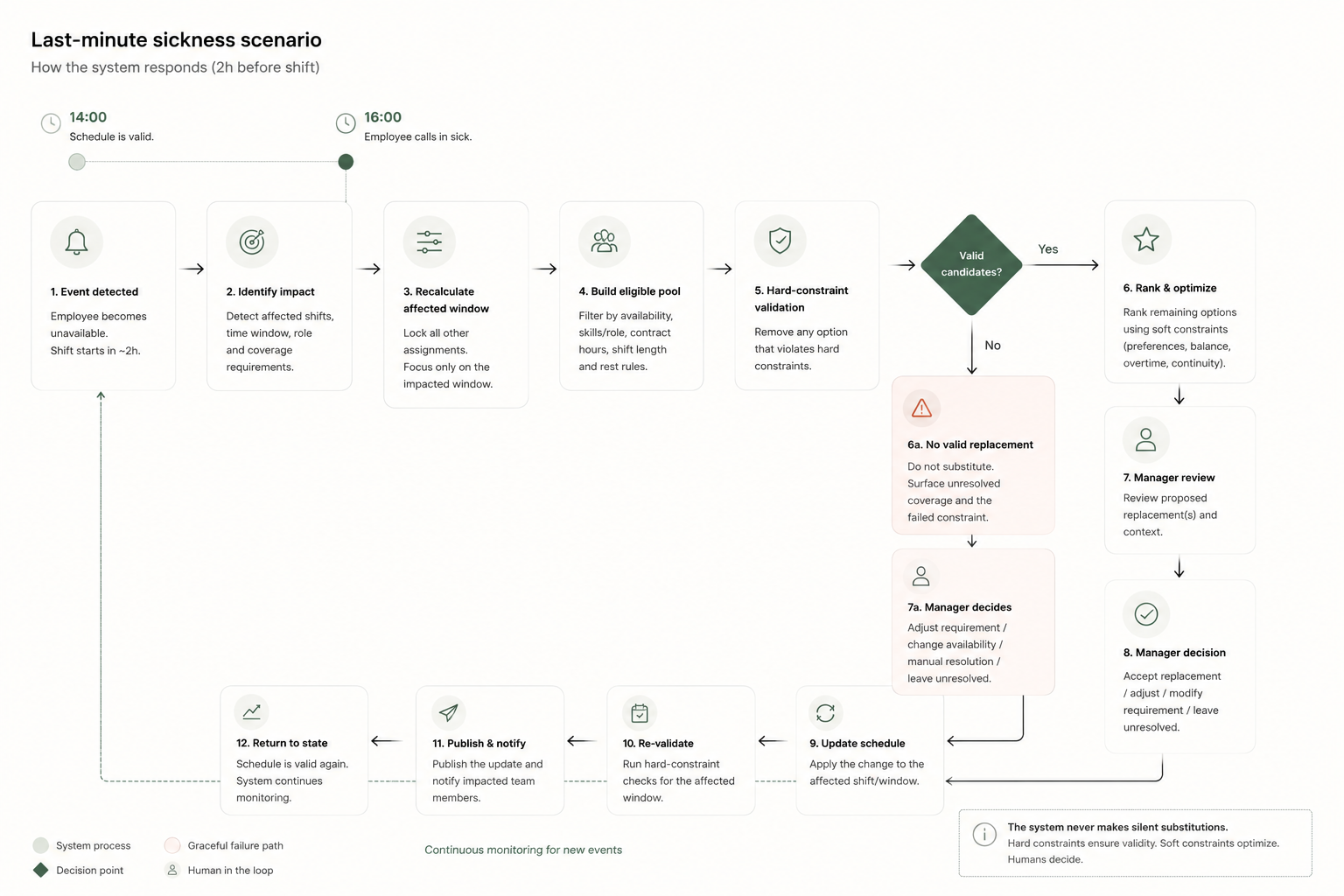
Architecture flow showing how SynchroShift handles a last-minute sickness: detect the affected window, build an eligible candidate pool, validate hard constraints, rank valid alternatives, keep the manager in the decision loop, revalidate and publish only the affected change.
Last-minute sickness / architecture flow
Example: an employee becomes unavailable two hours before a shift. The system isolates the affected window instead of rebuilding the entire schedule.
Decision boundary
Hard constraints determine validity; soft constraints rank valid alternatives. If no valid replacement exists, the system surfaces the conflict rather than silently substituting a role.
Manager stays
in control
DefineSet staffing and role requirements.
GenerateCreate a candidate schedule.
ValidateDetect conflicts and impossible coverage.
ResolveManager edits rules, people or assignments.
RegenerateRecompute only the affected portion.
Design outcome
Complexity is handled by the system. Accountability stays with the user.

The goal is not “AI makes the schedule”. The goal is a system that can reason about constraints, refuse invalid solutions, explain conflicts and let a manager make the final operational decision.

Outcome
SystemGenerate · validate · explain
ManagerReview · resolve · approve
BoundaryAI never hides an invalid schedule
Built as a focused “complexity → solution” reasoning case. Product UI is intentionally kept out of this story so the focus stays on problem decomposition, constraint logic, validation and failure handling.